
Yes. In fact, it already is.
Google Ads has been using machine learning for years for areas such as bidding, audience targeting and responsive search ads. What is changing now is the level of control being handed over to AI.
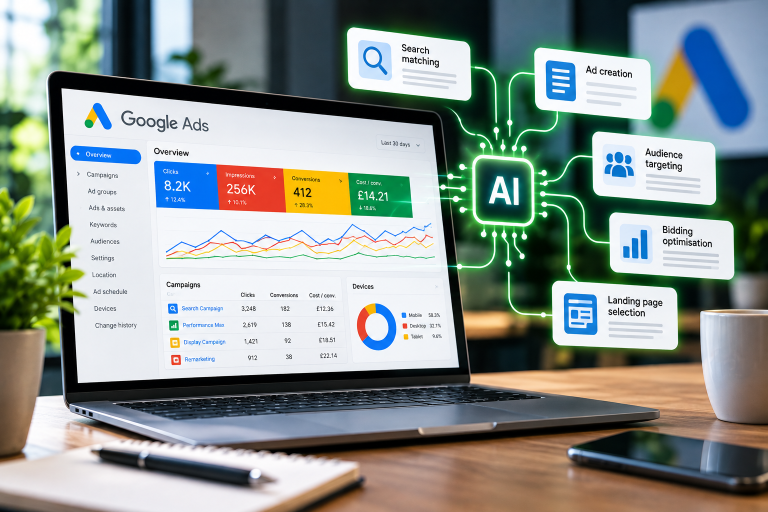
Google is increasingly using AI to decide which searches your ads appear for, which landing page to send people to, which headlines and descriptions to show and how much to bid in each auction.
For businesses using Google Ads, this does not mean campaigns can simply be left to run themselves. It means the role of the advertiser is changing.
Google Ads Is Becoming More Automated
One of the clearest examples is AI Max for Search campaigns.
AI Max uses Google AI to expand search term matching, optimise ad creative and select relevant landing pages based on a user’s intent. Google says advertisers using AI Max typically see around 14% more conversions or conversion value at a similar CPA or ROAS. Google Help
Google is also moving older features into AI Max. Campaigns using text customisation and campaign-level broad match began moving across from September 2026, while Dynamic Search Ads are due to start upgrading from February 2027. blog.google
That shows the direction Google Ads is heading.
Keywords May Become Less Important
Keywords are not disappearing, but they are becoming less central to how campaigns are managed.
Traditionally, advertisers would build campaigns around carefully selected keywords, match types and negative keywords.
AI-driven campaigns can now use:
- Existing keywords
- Website content
- Landing pages
- Search intent
- User behaviour
- Real-time auction signals
- Previous conversion data
Google can then match ads to searches that may not contain the exact keywords the advertiser originally selected.
AI Max, for example, uses broad match and keywordless technology to identify additional relevant searches. Google Help
For advertisers, this means the quality of the website and landing pages becomes even more important.
Your Website Will Have More Influence on Your Ads
As Google Ads relies more heavily on AI, it needs to understand what your business actually offers.
Google can use your website content to decide:
- Which searches are relevant
- Which landing page should be shown
- What advertising messages might work
- Which products or services match a search
This means vague or poorly structured websites could increasingly limit advertising performance.
Clear service pages, accurate content and strong landing pages give Google better information to work with.
This is another reason businesses should avoid putting every service onto one general page.
Google Can Already Create Ad Copy
AI is also becoming more involved in creating adverts.
Google’s text customisation feature can generate additional headlines and descriptions using information from your domain, landing pages, existing ads and keywords. Google Help
The advertiser can still provide their own messaging, but Google can create additional variations designed to better match individual searches.
This has advantages, but it also means businesses need to monitor what is being generated.
AI does not understand your business in the same way you do.
Prices, guarantees, locations, services and other important claims still need human oversight.
Bidding Is Already Largely AI-Driven
One of the biggest areas of automation is bidding.
Google’s automated bidding strategies already use AI to determine how much to bid for individual auctions.
For example, Maximise Conversions uses Google’s AI to adjust bids in real time with the aim of generating the greatest number of conversions within the available budget. Google Help
This can take into account a large number of signals that would be impossible for someone to assess manually for every auction.
The trade-off is reduced manual control.
That makes accurate conversion tracking increasingly important.
If Google is optimising towards the wrong conversions, AI can simply become very efficient at generating the wrong results.
AI Mode Could Change Where Ads Appear
The change is not limited to campaign management.
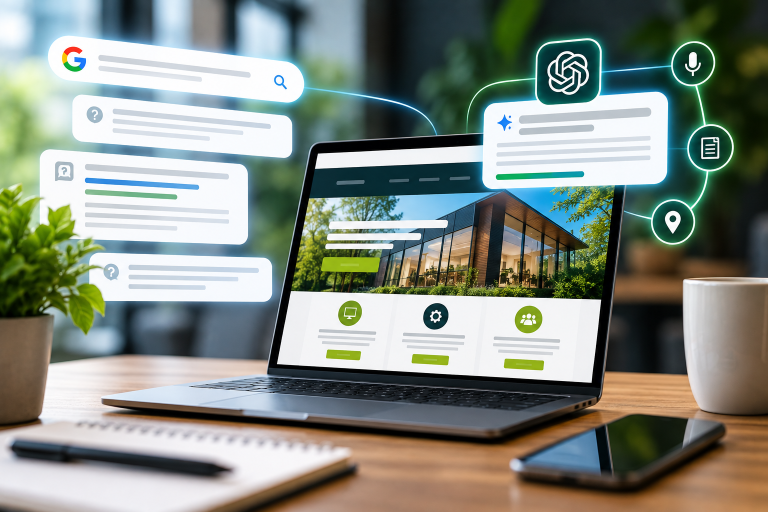
Google is also experimenting with new advertising formats inside its AI-powered search experiences.
Google has announced new ad formats for AI Mode designed to appear as part of conversational search journeys, including ads that provide additional product information and AI-generated explanations. blog.google
This could significantly change how people encounter paid advertising.
Instead of seeing a traditional advert alongside ten blue search results, someone may receive an AI-generated answer with relevant advertising integrated into the experience.
Will Advertisers Lose Control?
Possibly, in some areas.
Google Ads has gradually moved away from giving advertisers complete control over every individual decision.
The direction is towards providing Google with:
- Business goals
- Budgets
- Conversion data
- Creative assets
- Landing pages
- Audience information
- Brand guidance
Google’s AI then determines how best to use those inputs.
However, Google is also adding controls to AI Max, including settings around brand messaging, targeting and matching requirements. blog.google
The challenge for advertisers will be knowing when to allow automation and when to restrict it.
Does This Mean Google Ads Management Is No Longer Needed?
No.
If anything, the management role becomes more strategic.
Instead of spending all of the time adjusting bids manually, advertisers need to concentrate on areas such as:
- Conversion tracking
- Campaign structure
- Budget allocation
- Search term quality
- Negative keywords
- Landing pages
- Geographic targeting
- Ad messaging
- Lead quality
- Overall profitability
Someone still needs to decide whether the results Google considers successful are actually valuable to the business.
Ten cheap enquiries are not necessarily better than three enquiries that turn into profitable customers.
Small Budgets Will Need Careful Management
This is particularly important for small businesses.
AI systems generally work better when they have enough conversion data to learn from.
A business spending a relatively small amount each month may not generate enough data for every automated feature to work effectively.
Google also warns that AI Max may be less effective when campaigns are limited by budget. Google Help
For smaller advertisers, campaign focus will remain important.
Trying to advertise too many services, locations or objectives from a limited budget can spread the available data too thinly.
Conversion Tracking Will Become Even More Important
AI can only optimise towards the information it receives.
If your campaign records every contact form submission as a successful conversion, Google will try to generate more of them.
But that does not tell Google whether those enquiries were genuine, relevant or profitable.
As automation increases, businesses should pay more attention to:
- Which actions count as conversions
- Whether calls are being tracked
- Whether leads are genuine
- Which enquiries become customers
- The value of different conversions
Better data should give the AI a better chance of making useful decisions.
AI Will Not Fix a Poor Campaign
It is easy to assume that artificial intelligence will automatically improve advertising.
It will not.
AI cannot compensate for:
- A poor website
- Weak landing pages
- Incorrect location targeting
- Bad conversion tracking
- An unrealistic budget
- Poorly defined services
- Uncompetitive pricing
- Weak offers
Automation can amplify what already exists.
If the foundations are wrong, it can also waste money faster.
What Should Businesses Do Now?
There is no need to completely change your Google Ads strategy overnight.
The sensible approach is to test AI features carefully and compare performance.
Google provides AI Max experiments that allow advertisers to test the technology within an existing campaign before applying it more widely. Google Help
Businesses should also concentrate on improving the information they provide to Google.
That means better landing pages, accurate conversion tracking, clear service content and regular monitoring of search terms and lead quality.
The Future of Google Ads Will Be More AI-Driven
Google Ads is unlikely to return to a system where advertisers manually control every keyword, bid and advert.
AI is becoming part of targeting, bidding, creative generation, reporting and even the way advertisements appear in search results.
Google has also started introducing AI-powered summaries and reporting tools inside Google Ads and Analytics, allowing marketers to ask questions and create reports using natural language. blog.google
The businesses that benefit most are likely to be those that combine automation with good human judgement.
AI can process enormous amounts of data and make decisions quickly.
But businesses still need someone to decide whether those decisions are producing the right customers and a worthwhile return.
At Green Tornado, we manage Google Ads campaigns for businesses that want their advertising monitored rather than simply switched on and left to Google’s automation.
As Google Ads becomes more AI-driven, that combination of technology, accurate data and human oversight is likely to become even more important.